Most visitors never leave the coast, which is understandable and also a shame. It is one of several day trips in our guide to things to do in Dubai. Ninety minutes inland from Dubai the ground rises into the Hajar mountains, the temperature drops a few degrees, and there is a reservoir the colour of a swimming pool sitting between bare brown peaks. Hatta is the day trip that does not look like the rest of the UAE.
Where it is, and the border question
Hatta is part of Dubai, but it is an exclave: the road from the city crosses a stretch of Omani territory on the way. In practice this is no longer an issue on the main route, which runs entirely inside UAE territory. If you are driving yourself, use the newer road through Madam rather than the old one, and carry your passport anyway. On a tour it is handled for you.
Hatta Dam
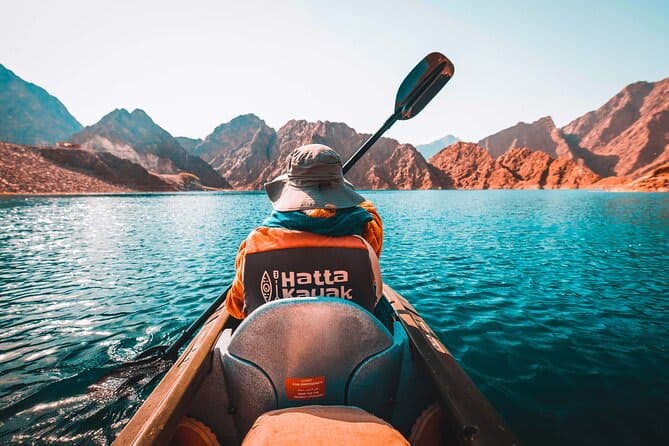
The reason the photographs look fake. The reservoir behind the dam is a deep turquoise, the result of mineral content in the rock, and it sits in a gorge with nothing green anywhere near it. You can look at it from the road above or get on it.
Kayaks and pedal boats are rented by the hour at the water. The reservoir is flat, enclosed and shallow at the edges, so this is a reasonable first kayak for someone who has never been in one. Mornings are calmer and cooler; by mid afternoon in summer the rock is radiating heat.
Hatta Wadi Hub
An activity centre built into the hillside above the dam, with mountain bike trails, a zip line, archery, axe throwing, a drop slide and a via ferrata. It works as a two hour stop or a whole afternoon depending on how much you want to do. Activities are individually priced on site, so decide what you want before you arrive and you will not overspend at the counter.
Hatta Heritage Village
A restored mountain settlement with two watchtowers, a fort, a mosque and a falaj irrigation channel running through it. Small, free, and the most informative thirty minutes of the day. The watchtowers are the oldest structures in Dubai.
The drive
This is a real part of the day rather than something to endure. The road leaves the city, crosses open desert with camel farms on both sides, then climbs into the mountains through switchbacks with pull offs. The rock changes colour with the sun. Two or three stops for photographs is normal and the good ones are not signposted, which is one argument for a driver who knows the road.
When to go
October to April is comfortable all day. In midsummer, go early, do the water and the shade, and be heading back by early afternoon. Winter mornings in Hatta can be genuinely cold by UAE standards, around 12 to 15 degrees, so take a layer. Rain is rare but when it comes the wadis fill quickly and routes close; the authorities take this seriously and so should you.
What to take
- Closed shoes with grip. The rock is loose underfoot almost everywhere.
- A change of clothes if you plan to kayak. You will get splashed.
- Sun cover. There is very little shade outside the Wadi Hub.
- Cash is not needed but a card is, for activities on site.
- More water than you think. The dry air hides how much you are losing.
Doing it as a tour
Our Hatta mountain day tour is about nine hours from your Dubai hotel, from AED 249 per person on a shared basis, and takes in the dam with kayaking or pedal boats, the Heritage Village and the Wadi Hub, with photo stops on the mountain road. Hotel pickup and drop off across Dubai are included and the vehicle is air conditioned.
Free cancellation up to 48 hours before departure, because the day is weather dependent and we would rather you moved it than sat in a vehicle in the rain.
If you would rather not share the vehicle, the same day runs as a private Hatta tour with your own SUV and driver, which also lets you start when you like and stay longer at the dam.
Who it suits
Anyone who has done the city and wants a day that is not about shopping, height or air conditioning. It works for families with children old enough to kayak, for couples, and particularly for second visits. It does not suit anyone with limited mobility: the sites involve uneven ground and steps, and the Heritage Village is built on a slope.